Need help?
Our friendly support team is here for you
Whether it’s technical issues, account questions, or general enquiries, our team is ready to assist. Submit a support ticket or call our help desk for fast, reliable assistance.
Support ticket
Create a support ticket by completing the form below and your enquiry will be escalated to the correct team member for a quick response.
Help desk
You can contact our help desk between 9:00 AM and 5:00 PM Monday to Friday.
1800 100 800
Calling from outside Australia
+61 3 8566 8900
Getting on-board
Helpful information to make it easy for you to get-on-board and start using your MOVOX services.
Creating your account
Creating your account with MOVOX takes just a few minutes via our website at https://movox.com.au/create-account
When creating your account you'll require the following information:
Australian Business Number
If you are applying on behalf of a business registered for GST you will need your ABN
ID Verification
Your application is subject to verification of your identity using your Australian driver's licence, birth certificate, or passport.
Terms and conditions relating to your account
Your account is subject to our Customer Terms which can be found at https://movox.com.au/customer-terms
In addition to our Customer Terms, supply of Services will include one or more Order for Services and one or more Critical Information Summaries associated with your Service.
Questions regarding your account?
If you have quesitons relating to your account or our Customer Terms you can contact us by:
- calling 1800 100 800 and selecting option 4, between 9.00 am and 5.00 pm (AEST) Monday to Friday; or
- writing to us by completing and submitting the form on our Contact us page.
About number porting
Transferring phone numbers from your existing phone company to MOVOX is a seamless process referred to as local number portability, or number porting. It allows you to keep your phone numbers when relocating or changing phone company.
Your old phone system may have required a separate phone number for each simultaneous call. With MOVOX you can make multiple simultaneous calls using the one phone number. This means when transferring numbers to us you only need to transfer the phone numbers that people call you on.
Porting process
If you want to port your existing phone numbers to MOVOX:
- The numbers must be active. Do not disconnect your service with your current phone company as we cannot port your number if it has been disconnected;
- Service features associated with the number such as Internet or call forwarding must be removed prior to submitting a number transfer application;
- Once we have received your number porting application, we will contact your current phone company and initiate the transfer process;
- There are different timeframes depending on the number porting category associated with the service type and the quantity of numbers to be transferred. (See: Number porting categories for further information).
Rejection charges
Avoid rejection charges
In addition to number porting fees detailed above, other fees and charges may apply when porting your number from one phone company to another.
This may include:
- Early termination fee if you break your contract with your current phone company;
- Port away fees which may be charged by your current phone company. It’s best to refer to the Critical Information Summary associated with your current phone plan. These can be located on the website of your current phone company;
- Port Rejection Charges if your Porting Application is rejected by the losing carrier. The reasons and applicable charges for Port Rejections are detailed in the table below. If a Porting Application is rejected you will be charged the applicable number porting fee to resubmit the Port Application; and
- Outstanding call charges with your current phone company. Note that your current phone company cannot refuse to port your number if you owe them money for any outstanding balance on your account.
Number porting categories
Simple port – Category A
Service types categorised as a Simple port - Category A, include a single local service number beginning with 02, 03, 07 and 08.
Category A transfers generally take 4-6 business days to complete.
Complex port - Category C
Category C transfers require project management from both MOVOX and the losing carrier.
Service types categorised as a Complex port - Category C include:
- Multiple local numbers beginning with 02, 03, 07 and 08;
- Number blocks or a sequential range of numbers;
- 13, 1300 and 1800 inbound numbers; and
- Numbers associated with service features such as Internet or call forwarding
Category C transfers generally take 4-6 weeks to complete depending on complexity
Network readiness
Preparing your local network in accordance with our suggested settings will ensure that we deliver reliable communication solutions with crystal clear call quality.
Security
Protecting your computers and IP phones from online threats is essential.
Failing to secure your PBX or IP phones and devices may result in:
Toll Fraud – utilising your PBX, devices or account details to make calls at your expense;
Unauthorised access – to your system resources, information, privileges and listening to your calls and voicemail;
Denial of Service – disabling your voice communication using packet floods.
These security steps are critical to ensure your protection against hackers. If you require assistance configuring or implementing any of our recommendations, contact out Technical Support Team or your IT service provider.
To make sure that your network is more resilient to attacks and Toll Fraud, we recommend you do the following:
Passwords
Use a strong alphanumeric passwords for your IP phones and extensions. Change your router’s default "admin" password and replace it with something complex. Once done, document the new passwords and store them in a safe place for future reference.
Disable remote access
Remote access (or remote management) is a convenient way for users and technicians to manage your router over the internet but it can also be used by hackers to access your network and devices;
Block IP addresses
Only allow SIP authentication and inbound call requests from MOVOX’s trusted IP addresses and block all others. Please raise a Support Ticket to request MOVOX’s trusted IP addresses.
Use a firewall
Firewalls help protect against malicious software and prevent people from travelling through your internet connection to compromise your local network by limiting which ports can be used, IP addresses, and type of traffic. We recommend you start with a block-all policy and then add rules to allow access from trusted or known sources.
Keep device software up-to-date
Software and firmware updates are critical to the security and reliability of your computers, phones and other network devices. Some updates address bugs and potential exploits in your computer. We recommend you set a regular reminder to check and update your device software and firmware if necessary.
Use a non-standard access port
Protect the administration and remote management interface by using a non-standard access port.
Restrict International calls
Please raise a Support Ticket to request restrictions on calls to international destinations
Manage employee access
Delete employee authorisation codes when they leave your company.
Delete usernames and passwords
When discarding of storing IP phones and devices, ensure you factory reset devices and check that authentication usernames and passwords have been removed
SIP ALG
SIP ALG is a feature found in most networked routers, operating as a function of its firewall. It consists of two different technologies, explained below:
Session Initiation Protocol (SIP)
The underlying service that powers all Voice over Internet Protocol (VoIP) phones, apps, and devices. SIP manages registering devices, maintaining call presence, and overseeing the call audio. Read more about SIP in our deep dive here.
Application Layer Gateway (ALG)
Routers segments your ISP and your internal network through a process known as Network Address Translation (NAT). An ALG acts as a proxy to rewrite the destination addresses in data packets for improved connectivity.
SIP ALG interferes with IP and signalling protocols. If you are experiencing:
- Only one person can hear the other
- Phones do not ring when called
- Calls drop after being connected
- Calls go straight to voicemail
It is most likely that SIP ALG is enabled in your router. To disable SIP ALG, you will need to log into your router.
We’ve set out instructions on how to disable SIP ALG for commonly used routers such as Linksys, Netgear, D-Link and TP-Link. We recommend that you also refer to your router manufacturers' user guide for instructions specific to the make and model of your router.
TP-Link
Archer series
- Click on the Advanced Tab;
- Expand the NAT Forwarding menu on the left side of the screen;
- Uncheck SIP ALG, RTSP ALG, and H323 ALG checkboxes;
- Click Save.
Other TP-Link routers
Use the Telnet client from the Command Prompt and apply the following command:
ip nat service sip sw off
D-Link
- Click on Advanced Settings;
- Locate the Application Level Gateway (ALG) Configuration;
- Uncheck the SIP option; and
- Click Save.
DIR-655
- Click Advanced, located along the top;
- Click Firewall Settings on the left side of the screen;
- Uncheck Enable SPI;
- Set both UDP and TCP Endpoint Filtering to Endpoint Independent;
- Uncheck SIP from Application Level Gateway Configuration; and
- Click Save.
Netgear
With the Genie interface
- Select the Advanced tab at the top;
- Expand the Setup menu on the left of the screen;
- Click WAN Setup; and
- Check the box labelled Disable SIP ALG.
Other Netgear routers
- Under Security/Firewall, click on Advanced Settings;
- Disable SIP ALG;
- Locate Session Limit under Security/Firewall; and
- Increase the UDP timeout to 300 seconds
ASUS
- Under the Advanced Settings section, click WAN;
- Click the NAT Passthrough tab;
- Change the SIP Passthrough setting to “Disable.”;
- Click Apply.
Fortinet
Use the following commands from the CLI interface:
config system session-helper
show system session-helper
- Find the SIP session instance, indicated by #12;
- Delete #12 or the appropriate number; and
Confirm its deletion by executing this command:
show system session-helper
Ubiquiti
Use the configuration tree if supported:
system > conntrack > modules > sip > disable
Alternatively, you can SSH into the device and run the following commands:
configure
set system conntrack modules sip disable
commit
save
exit
Linksys
Smart Wi-Fi (E-series)
- On the left side of the screen, click on Connectivity;
- Click the Administration tab;
- Under Application Layer Gateway, uncheck SIP;
- Click Apply or Save;
Other Linksys routers
- On the Admin page, go to the ‘Advanced’; and
- Disable the SIP ALG feature.
Linksys BEFSR41 routers
- On the Admin page select Applications/Gaming;
- Click on Port Triggering;
- Type in ‘TCP’ as the application;
- Type in ‘5060’ into the Start Port and End Port for the ‘Triggering Range’ and ‘Forwarded Range’ fields;
- Check ‘Enable’; and
- Click on Save and Reboot.
Cisco
Cisco General and Enterprise-Class routers
- no ip nat service sip tcp port 5060;
- no ip nat service sip udp port 5060;
Cisco PIX routers
- no fixup protocol sip 5060;
- no fixup protocol sip udp 5060
Cisco ASA routers
- Locate ‘Class inspection_default’ under ‘Policy-map global_policy’; and
- Execute this command:
no inspect sip
Implementation
The successful implementation of your Cloud PBX phone system begins with understanding your current and future needs. If you're just starting out, expanding your business locally or internationally, your Cloud PBX needs to be flexible and grow with you.
With expert guidance from our dedicated project team we'll help design a solution to uniquely meet your business needs, implemented seamlessly, on-time and on budget.

Discovery
Current and future needs
Get to know your business and how customers, employees and suppliers communicate

Workflow
Design call flows
Consider processes, answering of calls, office-hours, voicemail management and features

Testing
Provision and assurance
Device programming, test call flows and failover, adjustments and fine-tune where required

Deployment
Installation and training
Delivery and installation of hardware, user training session on system features and sign-off

Support
Transition and support
Support for adding, moving or changing hardware and adapting for business change
Using our services
Learn how to use our services and get the most out of the product we offer
Feature codes
About feature codes
Feature codes are numbers dialled from your phone or softphone keypad.
They make it easy to turn on and off regularly used phone system features like; call forwarding, hotdesking, call parking and voicemail management.
This section sets out feature codes and how to use them with your MOVOX Cloud PBX, softphone application or other voice service.
Call forwarding
Enable Call Forwarding *72
This feature code is used to exclusively enable call forwarding. The default code is "*72", and when dialled a prompt will ask for the number to forward to. The caller is expected to enter the phone number then press pound, at which point call forwarding is enabled and the number is read back to ensure it wasn't misdialled. The feature code requires the caller to enter the phone number to forward to each time they use the code. Optionally they can dial the feature code as a prefix on feature code "*7215552489715", which will enable call forwarding to 15552489715.
Disable Call Forwarding *73
This feature code will disable any active call forwarding. Dialling the code, by default "*73", plays a prompt to the caller informing them call forwarding has been disabled.
Toggle Call Forwarding *74
This feature code will enable or disable call forwarding depending on if it is active when dialled by default "*74". Furthermore, this feature code remembers the last number you forwarded to and enables it without asking for a new number. If the caller has never enabled call forwarding then they will be prompted for the number. Like the enable call forwarding feature code, they can optionally prefix the code with a new call forwarding number.
(If the feature is enabled and they prepend the feature code it will disable call forwarding without storing the provided number.)
Update Call Forwarding *56
The update call forwarding feature code, by default "*56", will prompt the caller to enter a new call forwarding number. This immediately replaces any number currently being used, set either by the enable or toggle feature code. The number entered is also stored for later use with the toggle feature. The status of call forwarding will not be changed by this code, so if it is disabled or enabled it will remain so.
Hot desking
Enable Hot-desking *11
This feature code is used to "log in" to a phone. When *11 is dialled, the caller will enter their ID (and optionally a pin). Upon successful completion, the phone from which they enabled hot-desking will now ring when they receive a call, get updates about voicemail, and basically act like the user's phone.
Disable Hot-desking *12
This feature code is used to "log out" of a phone. Just as logging into the phone, once a user has dialled *12 and entered their ID and optional pin, the phone will cease to receive their inbound calls, voicemail updates, and other features. Inbound calls will likely go straight to voicemail (unless the user is permitted to be logged into multiple phones at once).
Toggle Hot-desking *13
This feature code is used to toggle the current state of the user's devices. If logged out, dialling *13 logs the user into owned devices. If logged in, toggling logs the user out of all the devices they're currently logged into.
Intercom and loud speaker
The intercom feature allows you to dial a phone and have the phone automatically go off-hook to speaker mode. This is useful for announcing callers or paging individuals who may not be near their phone.
Note that intercom is a phone-specific feature. Most phones support intercom but some do not.
Call parking
Call parking allows each user to have their own parking lot, and reception to be able to park calls for specific users. This is useful for allowing reception to answer calls and put them on hold for a specific party, who can see a light blinking on their phone when a call is waiting for them. The final party can answer the call once they are ready, or reception can “retrieve” the call if there is no answer.
Dialling *3 will park a call and retrieve a call from call parking.
To place a call into call parking:
- answer the call;
- press the transfer button on your handset;
- dial *3;
- wait for the system to tell you which spot the call has been placed into before hanging up.
To retrieve a call from call parking:
- dial *3;
- dial the parking spot number;
- wait to be connected to the parked call
Valet (*4)
Retrieve (*5)
Voicemail menu
The feature code *97 is used to access the main menu of a voicemail box.
When dialled the user can select from the sub-menus below:
Main menu
1 – to hear new messages
1 – save message
2 – replay message
7 – delete message
0 – return to the main menu
2 – to hear saved messages
5 – change your settings
1 – record your mailbox greeting
2 – record your name
3 – change your password
0 – return to the main menu
Voicemail
About voicemail
The MOVOX Cloud PBX system supports an unlimited number of voicemail boxes.
You can have a personal voicemail message on your phone, or a group voicemail message for your team, or department.
You can even set up voicemail messages for business hours, after-hours and holidays.
Voicemail recording files can be self-supplied, or subscribe to one of our professionally recorded message and greeting plans and we’ll upload the message for you.
You can listen to messages, save them, delete them and update your voicemail greeting by accessing your voicemail box.
Each voicemail box is allocated a voicemail 4-digit number. If the voicemail box is assigned to an individual user, the 4-digit number is usually the same as their extension number.
Managing voicemail
Listening to voicemail messages
Once you have setup your voicemail, you’ll receive new messages sent to your email as a .wav file attachment. To hear your voicemail message, simply click the .wav file to open and play using your computers media player.
If your using a physical desk phone, your handset may also indicate new messages with a flashing button, or icon on the device screen. Please refer to your handset guide.
To hear your voicemail message via your phone, simply press the message button on the handset keypad, or dial *97. A voice prompt will announce the date and time of the voicemail message and guide you through various functions such as saving and deleting the voicemail message from your phone.
Deleting voicemail messages
To delete messages and manage your voicemail settings, press the message button on your handset, or dial *97 then enter your voicemail box nuber, followed by the hash (#) key. A voice prompt will guide you through various functions.
Note: When you delete a voicemail message on the phone this will not delete the voicemail message attached to your email. And vice versa, if you delete the voicemail email, this will not delete the voicemail message from the phone.
Voicemail menu
The feature code *97 is used to access the main menu of a voicemail box.
When dialled the user can select from the sub-menus below:
Main menu
1 – to hear new messages
1 – save message
2 – replay message
7 – delete message
0 – return to the main menu
2 – to hear saved messages
5 – change your settings
1 – record your mailbox greeting
2 – record your name
3 – change your password
0 – return to the main menu
Video guides
Our video guides provide a quick summary on personal and group voicemail setup and use.
Personal voicemail
Group voicemail
Softphones
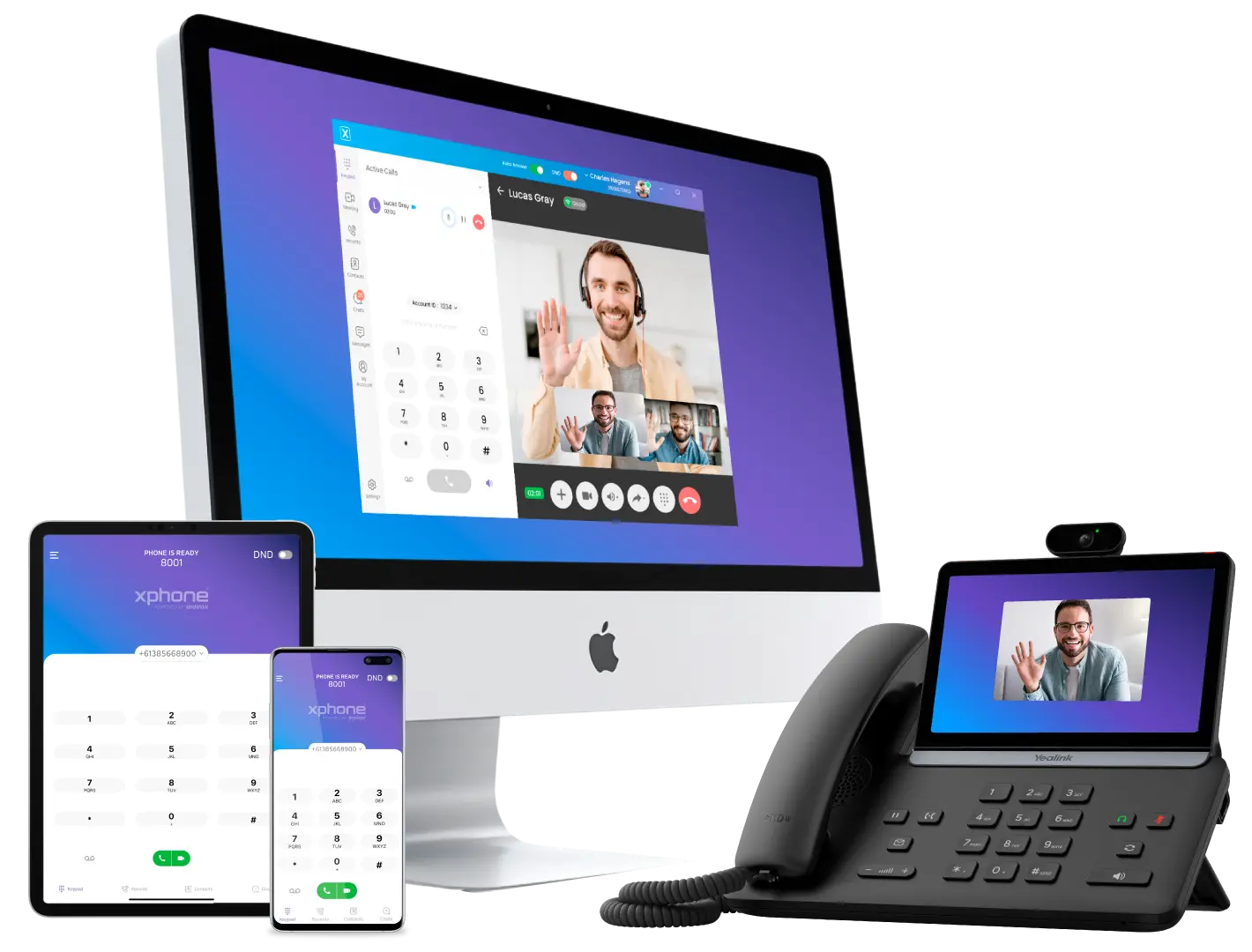
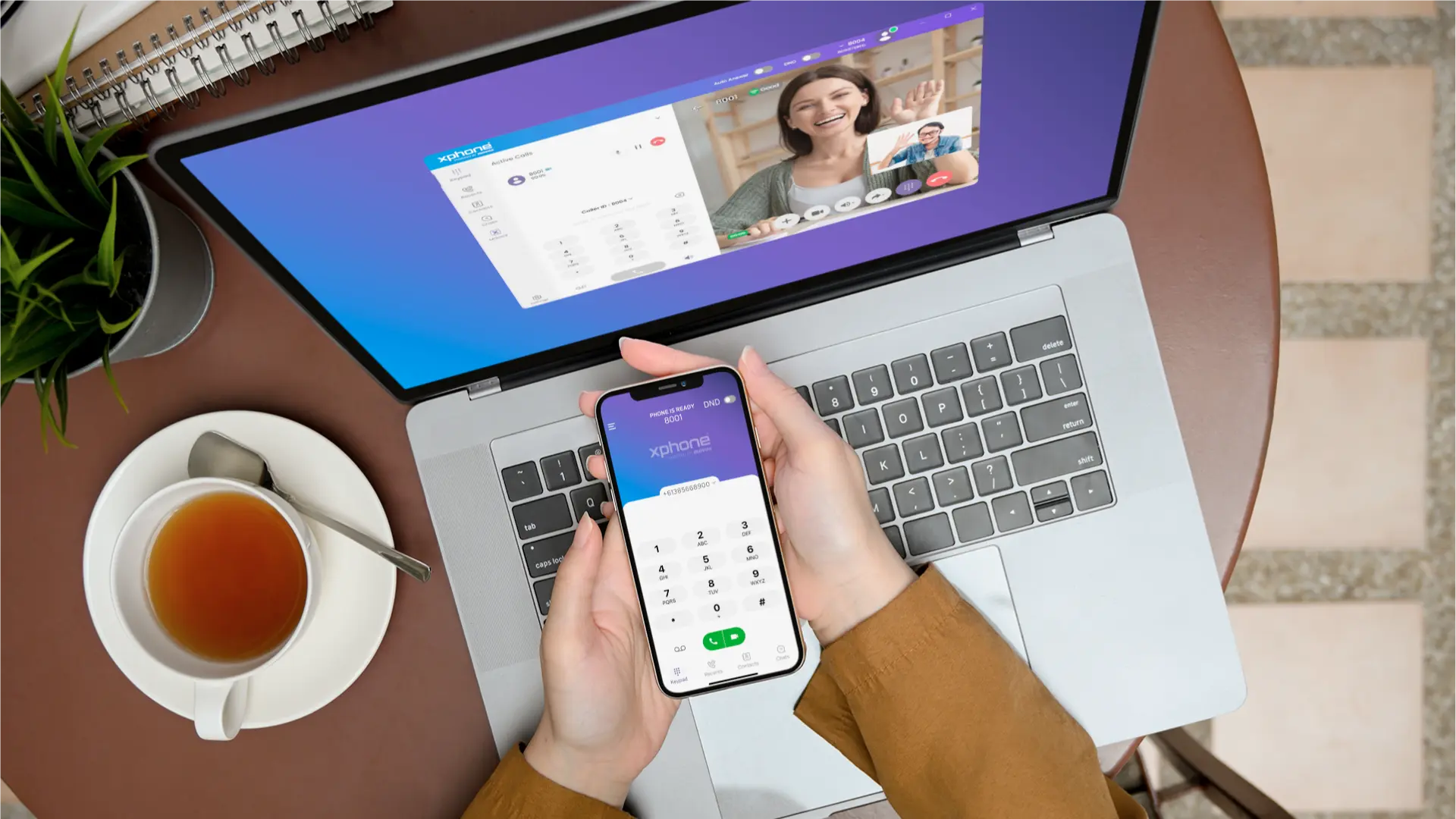
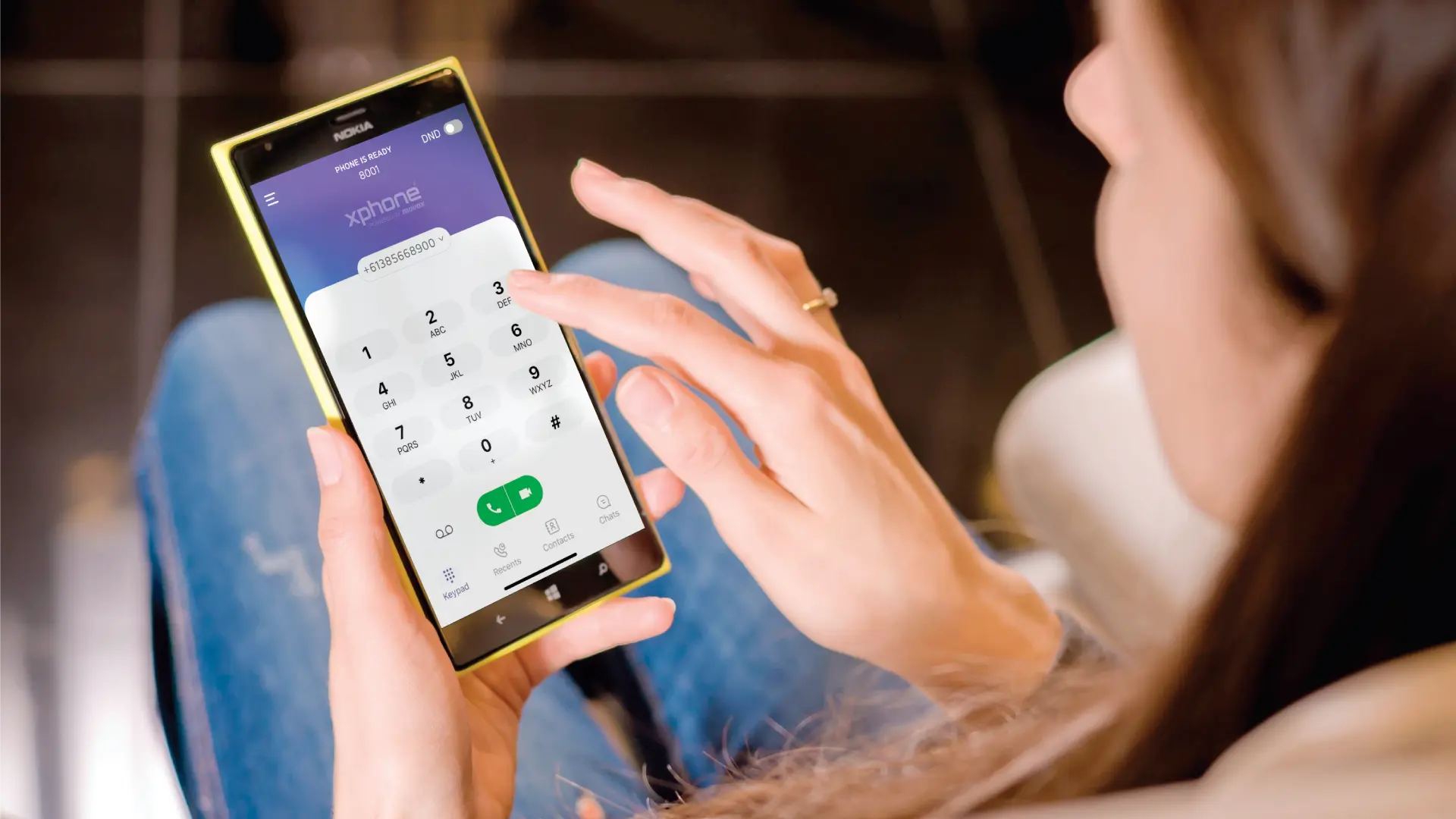
A softphone is a software application for your mobile, computer, or laptop. Softphones
XPhone TM is MOVOX's softphone application available for iPhone and Android mobile devices and Windows PC's and laptop's. The application requires a subscription to our Softphone Plan 10 or Softphone Plan 20.
Where do you get the application?
You can download the softphone application to your mobile device from the App Store or Google Play. The Windows desktop version can be downloaded by clicking the Windows icon below.
Use your company phone number
Softphones enable you to use your company phone number on your mobile phone or computer to make, receive and transfer calls just like you were sitting at your desk.
Video guide
Watch our softphone video for a quick summary on how the softphone application works.
User guide
Click the images below to download our XPhone TM softphone application user guides.
Softphone FAQ's
What is a softphone?
A softphone is a software-based telephony application that lets you make and receive voice/video calls over the internet using VoIP technology — eliminating the need for physical desk phones.
Do I need specific hardware?
No. A stable internet connection and a compatible device (PC, tablet or smartphone) are all you need. A headset is recommended for desktop calling.
Will my business phone number show on outbound calls?
Yes — XPhone ensures your business identity is displayed, maintaining professional communication everywhere you go.
Can I use my own softphone with MOVOX?
The MOVOX XPhone TM softphone application is free to download and has been designed to work with MOVOX's service and provides all the features and functions included in our Cloud PBX phone system.
Not all softphone applications will connect with MOVOX's service. If you intend to use your own softphone application with MOVOX we recommend that you contact our Help-desk to confirm the softphone's suitability.
What does the softphone application cost?
The MOVOX XPhone <sup>TM</sup> softphone application is free to download for mobile devcies from the App Store and Google Play and via our website if using our Windows desktop softphone application.
The use the softphone application you will require an active subscription to our Softphone Plan 10 or Softphone Plan 20.
Call quality
Identifying call quality issues
The are many reasons why you may experience issues with call quality. In most instances the cause of call quality issues can be identified (and fixed) by performing basic troubleshooting techniques which are set out below.
To isolate and guide you to the potential cause and solution of call quality issues, please proceed through the following Q&A table:
| 1. How would you decribe the problem? | ||
| A. Phones do not ring when called B. Calls drop after being connected C. Calls go straight to voicemail D. Only one person can hear the other E. There's a delay for either person hearing the other F. The call audio is distorted, choppy, garbled, or echoing |
||
| 2. How many devices expereince the call quality issue | ||
| A. on 1 single phone | B. a few phones, but not all | C. on all phones |
| 3. When do you experience the call quality issue | ||
| A. every now and then | B. most calls, but not all | C. on every phone call |
| 4. What is the direction of the call | ||
| A. Inbound (calls received) | B. Outbound (calls made) | C. Both inbound & outbound |
Disable SIP ALG
SIP ALG is a feature found in most networked routers, operating as a function of its firewall.SIP ALG interferes with IP and signalling protocols. If you are experiencing:
- Only one person can hear the other
- Phones do not ring when called
- Calls drop after being connected
- Calls go straight to voicemail
It is most likely that SIP ALG is enabled in your router. To disable SIP ALG, you will need to log into your router.
Please navigate to > Getting on-board > Network readiness for instructions on how to disable SIP ALG for commonly used routers. Alternately, please refer to your router user guide.
Jitter
Call quality issues related to jitter manifest as disarranged sound. These issues happen because of the way phone calls are transferred over the internet. When on a call, your voice is converted into data packets and then sent over the internet to the person you’re speaking with.
When there’s a delay in transmission, data packets can get jumbled or have gaps. You can fix jitter with a jitter buffer. A jitter buffer temporarily stores data packets in the right sequence and transmits them in intervals. As a result, clear audio reaches its recipient with minimum delay.
Latency
Latency is a delay between when one person says something and the other person hearing it. It may seem that you and your caller are talking over each other and you can hear your own voice on the call.
There are a few types of latency that happen on calls: propagation delay, handling delay, and queuing delay. Latency can be solved and prevented by prioritising SIP traffic in your network router by using:
- Bandwidth reservation
- Policy-based network management
- Multi-Protocol Label Switching (MPLS)
Prioritising SIP traffic over the network will improve both latency and jitter.
Please refer to your router user guide or network technician to prioritise SIP traffic.
Video guides
Number porting
Transferring calls
Connecting your phone (via router)
Connecting your phone (via PC)
Your account
Important information about how to manage your account and paying for the services you have with us.
About your bill
Our bills are designed to be viewed online in your web browser. From your web browser bills can be printed, saved or forward to someone else.
Your bill is categorised into the following sections:
- Account activity;
- Plans & usage;
- Usage detail; and
- Other services
Clicking any summary section, content box, heading or product icon will reveal detailed information and usage charges.
Your bill may take several seconds to appear depending on the amount of data contained in your bill, the larger the bill the longer it will take to open in your browser.
Use BPAY to pay from your bank account or credit card. Sign into your online banking to setup BPAY. Your MOVOX BPAY biller code and reference number are located at the bottom of your invoice cover page. Use Direct Debit to automatically debit the invoice amount from your bank account on the due date. To setup Direct Debit please complete and submit the Direct Debit Request (DDR) form. Call 1800 100 800 (option 1) any time to pay by Visa, MasterCard, AMEX or Diners. Your MOVOX biller ID and reference number are located at the bottom of your invoice cover page. To pay your bill by Visa, MasterCard, AMEX or Diners go to: https://movox.com.au/pay-a-bill Your MOVOX biller ID and reference number are located at the bottom of your invoice. Customers who have failed to pay their account in full by the due date will be sent an overdue notice on the third day following the due date. The overdue notice will be sent by email. It advises the customer that MOVOX has not received payment of their account to pay within 7 days. The notice also advises to disregard the notice if they have made a payment within the past 3 days. If you are having difficulty in paying the invoiced amount please email us at accounts@movox.com.au or call us on 1800 100 800 (Mon-Fri, 9am-5pm AEST). There’s no surcharge when using VISA or MasterCard. AMEX and Diners Club cards incur 4% payment surcharge. If you’ve subscribed to one of our recurring plans we'll send a monthly invoice to your nominated email address, which will contain details of your services and itemise any charges for each service, such as call charges. The email will contain a “view bill” button, when pressed your bill will automatically open in your web browser. Monthly bills include recurring charges in advance and usage charges incurred in previous billing periods. Your online bill is dynamic, we’ve designed it to be easily read as a summary or by clicking any content box, heading or product icon you can view detailed information and usage charges. We’ll send you an email each time a new bill is issued. To view your bill click the link within the email or login to your account to view current and past bills. To view itemised charges, expand sections of your bill by clicking the down V arrow next to section headings If you have more questions
BPAY

Direct debit

By phone

Online
Payment FAQ's
What happens if I don't pay my bill by the due date?
Is there a surcharge if I pay using my credit card?
Payment FAQ's
How and when will I receive my bill?
Where can I view my itemised charges?